






SYDNEY CBD
SYDNEY CBD

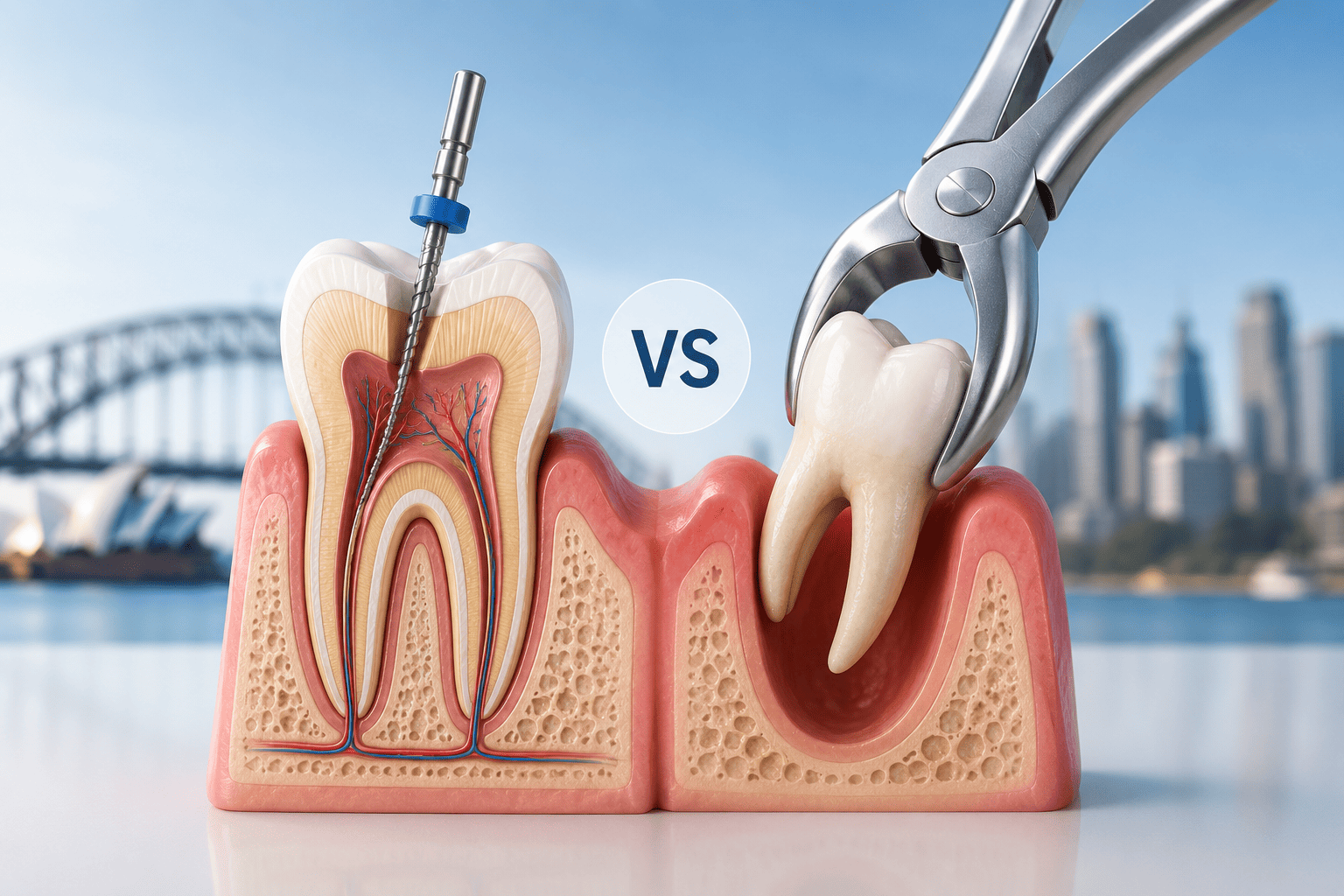
Most people in Sydney overlook dental health, thinking it poses no serious health concerns… until it does. Dental problems can really cause discomfort and inconvenience if not treated at the right time.
If you are someone who’s dealing with a damaged, decayed or infected tooth, you may be wondering about your next step. In many cases in Sydney, endodontists usually recommend either a root canal treatment or tooth extraction, depending on the tooth’s condition and whether it can be saved.
While both treatments have their own advantages and disadvantages, the ultimate aim behind both procedures is to alleviate pain and stop your oral issues from progressing.
It might sound like a simple choice, “save the tooth or remove it”, but it is important to understand both the treatments before taking a final call.
So let us settle this once and for all, so you can make well-informed decisions about your oral health.
Root canal treatment is a dental procedure that cleans out the infected or damaged pulp*, seals the canal, and saves the natural tooth. The tooth stays in your mouth, functional and intact.
Pulp can get infected for various reasons, including deep decay, a crack, trauma or repeated dental work.
Note: *Pulp is the soft inner part of the tooth containing blood vessels, nerves and connective tissues.
A root canal treatment in Sydney is planned step by step, so the tooth can be treated carefully and comfortably. The procedure usually includes:
The dentist or endodontist first examines the tooth and checks your symptoms. X-rays may be taken to see the shape of the roots, the depth of infection, and whether there is any damage around the bone.
A local anaesthetic is used to numb the tooth and the surrounding area. This helps keep the treatment comfortable, especially if the tooth has been painful or sensitive before the appointment.
A small opening is made in the tooth to reach the infected or inflamed pulp. The damaged tissue is then removed from the pulp chamber and root canals using fine dental instruments.
The root canals are carefully cleaned, shaped, and disinfected. This step helps remove bacteria and prepares the inside of the tooth for filling.
Once the canals are clean, they are filled with a safe, biocompatible material, commonly gutta-percha. This helps seal the space and reduce the chance of reinfection.
The tooth is then sealed with a temporary or permanent filling. In many cases, especially for back teeth, a crown is recommended to restore strength, protect the tooth, and help it handle normal chewing again.
In simple terms, root canal treatment removes the infection while allowing you to keep your natural tooth. It helps restore comfort, maintain chewing function, and avoid extraction when the tooth can still be saved.
Early signs that indicate you may need a root canal include:
These signs often indicate that the nerve inside the tooth is inflamed or infected and should be checked before the problem worsens.
Root canal treatment helps relieve pain, remove infection, and save your natural tooth.
Key benefits include:
In short, root canal therapy protects your tooth, your bite, and, hence, your smile.
Tooth extraction is a process in which your tooth is removed from the socket. It is usually recommended when the tooth cannot be saved, or when trying to save it would only lead to more pain and repeated treatment.
Tooth extraction is usually planned carefully after the dentist checks whether the tooth can be saved or needs to be removed.
The dentist or oral surgeon first examines the tooth, gum, bone, and surrounding area. X-rays may be taken to understand the tooth position, root shape, infection, or damage.
A local anaesthetic is used to numb the tooth and the nearby gum. For more complex cases, sedation may be discussed to help you feel more comfortable.
The tooth is gently loosened and removed from the socket using dental instruments. If the tooth is broken, impacted, or difficult to access, it may need to be removed in smaller sections.
Once the tooth is removed, the area is cleaned. Stitches may be placed if needed. Your dentist will then give you aftercare instructions to help manage discomfort, protect the clot, and support healing.
Tooth extraction can relieve pain when a tooth cannot be saved, but it also means the tooth is permanently lost. This is why dentists usually consider the long-term effect on your bite, chewing, and oral health before recommending removal.
Your dentist may recommend tooth extraction if the tooth cannot be safely restored or is affecting nearby teeth.
Common reasons include:
Tooth extraction is usually considered when saving the tooth is no longer the most predictable or healthy option.
Tooth extraction can be helpful when a tooth is too damaged, infected, or crowded to be kept.
Key benefits include:
Tooth extraction is usually recommended when keeping the tooth would cause more harm than good.
Most people worry about this part. Both treatments are done with local anaesthetic, so the procedure itself should be comfortable. The difference is usually felt during recovery.
You may have:
You may have:
Overall, root canal treatment is often the easier option when the tooth can be saved. It removes the infection, keeps your natural tooth in place, and may help you avoid the extra time, cost, and appointments involved in replacing a missing tooth.
One of the biggest reasons patients lean toward extraction is the upfront cost comparison. And that is fair. Root canal cost in Sydney does vary depending on the tooth involved, complexity, and whether you visit a general dentist or a specialist endodontist.
General ballpark for root canal treatment in Sydney:
A straightforward extraction might cost $150 to $400. Surgical extraction (for impacted or complex teeth) can run $300 to $800.
But here is where the maths shifts completely.
If you extract a tooth and do nothing, you face shifting, bone loss, and bite problems within a few years. If you replace it (which most dentists will recommend), you are looking at:
Suddenly, the root canal that felt expensive looks like the budget-friendly option. This is something every experienced endodontist in Sydney will walk you through during your consultation, not to upsell you, but because the numbers genuinely matter to your decision.
Endodontists are tooth-saving specialists. Their entire training is built around preserving natural teeth. So when they recommend an extraction, it carries real weight.
Extraction is typically the right call when:
In these situations, holding onto a failing tooth creates more harm than good. An experienced endodontist in Sydney will assess this through detailed X-rays, often cone beam CT scanning, before making any recommendation.
General dentists can perform root canals, and many do them well. But an endodontist in Sydney completes two to three additional years of specialist training focused entirely on the pulp and root systems of teeth.
They use equipment that most general practices do not have, including dental operating microscopes, CBCT imaging, and advanced irrigation systems. For complex cases, multi-canalled molars, calcified canals, curved roots, or retreatments after a failed first attempt, an endodontist’s training makes a significant difference to the outcome.
When patients in Sydney search for a specialist, they are usually in a situation where a general dentist has referred them or where a previous treatment has not worked. In both cases, seeing a dedicated endodontist in Sydney gives you the best shot at saving the tooth.
If you are experiencing any of the following, book an appointment rather than hoping it resolves on its own. Dental infections do not self-correct.
The earlier you get assessed, the more options you have. Waiting turns a potentially straightforward root canal into either a far more complex procedure or an extraction by default.
Root canal treatment in Sydney is not the ordeal its reputation suggests. It is a precise, well-established procedure that saves teeth, avoids bone loss, and, when you factor in the long-term costs of replacing an extracted tooth, almost always makes more financial sense, too.
If you are in pain right now or have been putting off a dental appointment because you are not sure which direction to go, getting a proper assessment is the only way to know what your tooth actually needs. A consultation with an endodontist in Sydney will give you a clear picture of whether your tooth is saveable and what that treatment will realistically involve and cost.
Remember that saving your tooth today is almost always easier and cheaper than replacing it tomorrow.
At Smile Concepts, we help patients understand what is really happening with their tooth before making a decision. If root canal therapy can save your natural tooth, we will explain the process clearly and guide you through it with care. If extraction is the better option, we will be upfront about that, too. Our goal is to help you get out of pain and choose the treatment that makes sense for your long-term oral health.
Book a consultation with Smile Concepts today and find out whether your tooth can be saved with root canal care in Sydney.
Note: This blog is written for general educational purposes. Individual treatment recommendations depend on clinical assessment by a qualified dental professional. Always consult a registered dentist or specialist endodontist for advice specific to your situation.
Most root canals are completed in one to two appointments. Simple single-canal teeth may be done in 60 to 90 minutes. Complex molars or severely infected teeth may require a second visit to complete.
If the molar can be cleaned, sealed, and protected with a crown, root canal treatment may be recommended. If it is cracked below the gumline, loose, or badly damaged, extraction may be more suitable.
Medicare does not cover general dental treatment for adults. Private health insurance with major dental cover typically contributes to root canal costs in Sydney. Check your policy’s annual limits and whether specialist referrals are covered.
Yes, in most cases. Root canals use local anaesthesia, not general sedation, so you will be fine to drive. If you have opted for additional sedation (available at some practices), you will need someone to drive you.
A properly treated and restored tooth can last a lifetime. The tooth needs a crown in most cases after root canal treatment to protect it from fracture. With that crown in place, long-term success rates are very high.
Yes, and untreated dental infections during pregnancy carry far greater risk than the treatment itself. Let your endodontist know you are pregnant so they can adjust X-ray precautions and medication choices accordingly.
Smile Concepts is a high-end dental clinic in the heart of Sydney. To deliver the best service, we always prioritise your wellbeing so we can use our expertise to help you live a better life.


Dr. Manish Shah is a cosmetic dentist with a special interest in porcelain veneers, dental implants and Invisalign in Sydney.
Dr. Kinnar Shah is a cosmetic dentist with a special interest in cometic dentistry, porcelain veneers and dental implants practising at Smile Concepts.