SYDNEY CBD




SYDNEY CBD
SYDNEY CBD
SYDNEY CBD

There’s a particular kind of denial that happens the moment you chip a tooth. You feel it break, fish the fragment out, run your tongue over the jagged edge, decide it’s smaller than it felt, and then spend the next few weeks convincing yourself it’s probably fine. The tooth doesn’t hurt much. It’s not visible when you smile. You’ll get around to it.
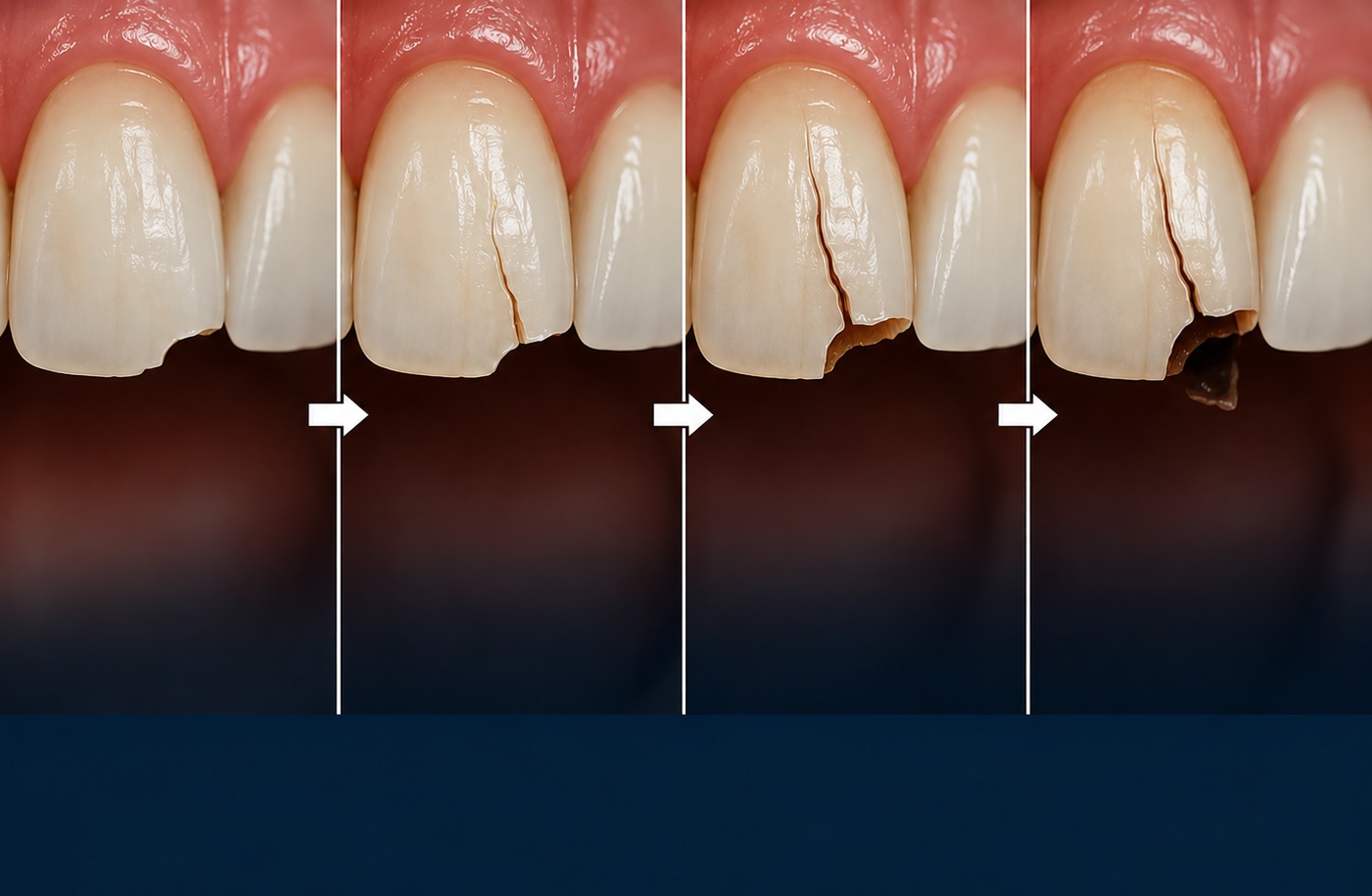
A small chipped tooth or cracked tooth rarely stays the same for long.
What nobody tells you is that the tooth has already started making its own decision about what happens next. Cracks don’t pause while you procrastinate. Every meal, every morning coffee, every night of clenching your jaw in your sleep applies pressure to that fracture line, and fracture lines, left alone, have only one direction to travel.
Many patients in Sydney searching for treatment for a cracked or chipped tooth don’t realise how quickly these fractures spread. Dentists in Sydney describe it this way: a crack in a tooth moves like a run in nylon stockings. Once it starts, it doesn’t stop by itself, and the further it travels, the fewer options you have left. So here are the five signs that yours is already on the move.
A chipped tooth has lost a piece of enamel. The damage is visible, structural, and usually contained to the surface, which makes it relatively predictable to treat when caught early.
A cracked tooth is a different animal. The fracture runs through the tooth rather than across it, travelling silently toward the root over weeks or months without any obvious change in appearance. Standard X-rays miss cracks regularly, which is part of what makes them so difficult to catch before they’ve already done real damage.
This one works backwards from what you’d expect. When you bite down, the crack gets compressed and the two sides of the tooth are briefly pushed together. The moment you release, they spring fractionally apart and the fluid inside the tooth’s internal channels shifts fast enough to trigger the nerve. Sharp, often electric, and unmistakable once you’ve felt it.
If your tooth is doing this, the crack has reached deep into the dentine and may already be approaching the pulp. A crack caught before the pulp is involved needs a crown. The same crack caught after needs a root canal first, then the crown. Same tooth, very different appointment.
Sensitivity that passes in a second or two is surface-level and common. What’s worth paying attention to is the sensitivity that lingers after the source is gone. You put the cold glass down and the ache is still sitting in the tooth 20 seconds later. You finish eating and the throb continues well past the last bite.
Healthy enamel keeps the temperature from reaching the nerve. When a crack removes that protection, every hot and cold hit the pulp directly. Treated early, an irritated pulp can sometimes settle once the tooth is sealed. Left longer, the damage becomes permanent and root canal treatment is the only way forward before any restoration can be placed.
It looks like a tiny ulcer, it’s not particularly painful, and it seems to disappear within a few days. The problem is that it keeps returning in exactly the same spot. That recurring bump is almost always a sinus tract, a small drainage channel the body creates to release pressure from an infection building inside the root. It drains, shrinks, refills, and repeats. The fact that it drains actually reduces the pain, which is exactly why people don’t take it seriously.
The infection won’t clear without treatment. If the swelling extends beyond the gum and is visibly affecting the jaw or neck, calling a dental practice is the right first call.
A single tooth going noticeably grey or brown compared to its neighbours, especially one with any history of being cracked, chipped, or knocked, has a specific clinical cause. Trauma disrupts the blood supply to the pulp, and as blood breaks down inside the tooth, iron compounds leach into the dentine and oxidise. The tooth stains itself from the inside out.
What catches people off guard is that a dead nerve stops hurting. The aching settles and it feels like the problem has resolved. It hasn’t. The bacteria responsible are still active inside the root and spreading into the surrounding bone. The tooth can still be saved, but that option has a time limit.
After a while, you get used to a chipped or cracked tooth. This is the reason why it takes a moment to register when something changes. The edge is sharper. The crack looks longer. A new piece has come away without any obvious incident.
Enamel cannot repair itself, so every change reflects actual structural deterioration. A crack that stays within the crown can be stopped with a crown fitted over the top. Once it extends below the gumline into the root, extraction often becomes the only realistic path, and that transition happens quietly, without the dramatic pain you’d expect to signal something significant had shifted.
| What You're Feeling | What It Likely Means | What To Do |
|---|---|---|
Pain when releasing bite |
Crack deep in dentine |
Call today |
Lingering temperature sensitivity |
Pulp inflammation |
Call today |
Recurring gum bump |
Active abscess draining |
Call the same day |
Jaw or neck swelling |
Infection spreading |
Emergency department now |
Single tooth going grey |
Nerve dying or already dead |
Within days |
Crack visibly growing |
Fracture spreading toward the root |
Call today |
If a crack has extended into the root and the tooth genuinely cannot be saved, that will be communicated plainly, along with what the options are from there.
That’s the thing about a tooth that gets missed at the fixable stage. You don’t get to go back. A chip that walks through the door on a Tuesday afternoon might be a 45-minute bonding appointment and be done. That same chip, left for six months while life gets busy, can quietly turn into a fractured root, a dead nerve, or a tooth the dentist looks at and says there’s nothing left to save. The tooth doesn’t send a calendar reminder before it crosses that point.
Most cracked and chipped teeth are completely treatable, and people walk out of the appointment every day wondering why they put it off so long. But the window for the simpler treatment is real, and it’s worth knowing when yours might be closing.
If any of what’s described here sounds like your chipped or cracked tooth, the dentists at Smile Concepts in Sydney can take a proper look and give you a straight answer on where things actually stand for you. Smile Concepts provides emergency care for cracked tooth or chipped tooth cases in Sydney outside standard hours.
Call 02 9267 7777 or book online. Emergency care available outside standard hours.
Note: This blog is written for general educational purposes. Individual treatment recommendations depend on clinical assessment by a qualified dental professional. Always consult a registered dental practitioner for advice specific to your situation.
No. Enamel has no ability to regenerate. Without treatment, it stays structurally compromised and vulnerable to further fracture.
Yes. Pain is not a reliable measure of how serious a crack is. Some cracks reach the root or kill the nerve with barely a symptom. No pain doesn’t mean no problem, and sometimes it means the nerve is already gone.
If any of the five signs above apply, don’t. A small chip with genuinely no symptoms gives you a bit more time, but it still needs to be properly assessed at some point.
No. Many cracks are invisible to the naked eye and don’t show on standard X-rays. Proper diagnosis requires clinical testing that can’t be replicated by checking in a bathroom mirror.
Most major dental policies contribute toward crowns and restorative treatment. How much depends on your specific cover and annual limits, so a quick call to your insurer before the appointment is worth it.
Sleep dentistry is available for patients who’d rather not be aware of any part of the procedure for a chipped or cracked tooth. Mention it when you book and the team will talk through what suits your situation.
Smile Concepts is a high-end dental clinic in the heart of Sydney. To deliver the best service, we always prioritise your wellbeing so we can use our expertise to help you live a better life.


Dr. Manish Shah is a cosmetic dentist with a special interest in porcelain veneers, dental implants and Invisalign in Sydney.
Dr. Kinnar Shah is a cosmetic dentist with a special interest in cometic dentistry, porcelain veneers and dental implants practising at Smile Concepts.